I’ve been around dampers for a long time and have traveled to countless engine shops around the country to physically test crankshaft twist over the past 23 years. Throughout this time, I have collected considerable data that allows me to determine “how much damper” a certain engine needs. When given the crank weight, peak operating RPM, horsepower, rotating system materials, rules about the damper specifications (if racing), and the application of the engine (road racing, oval or drag), I can make a very good prediction about the amount of inertia weight and the type of device your engine will need. Having the ATI Super Damper that is “2 dampers in 1” and tunable, certainly helps make that possible.
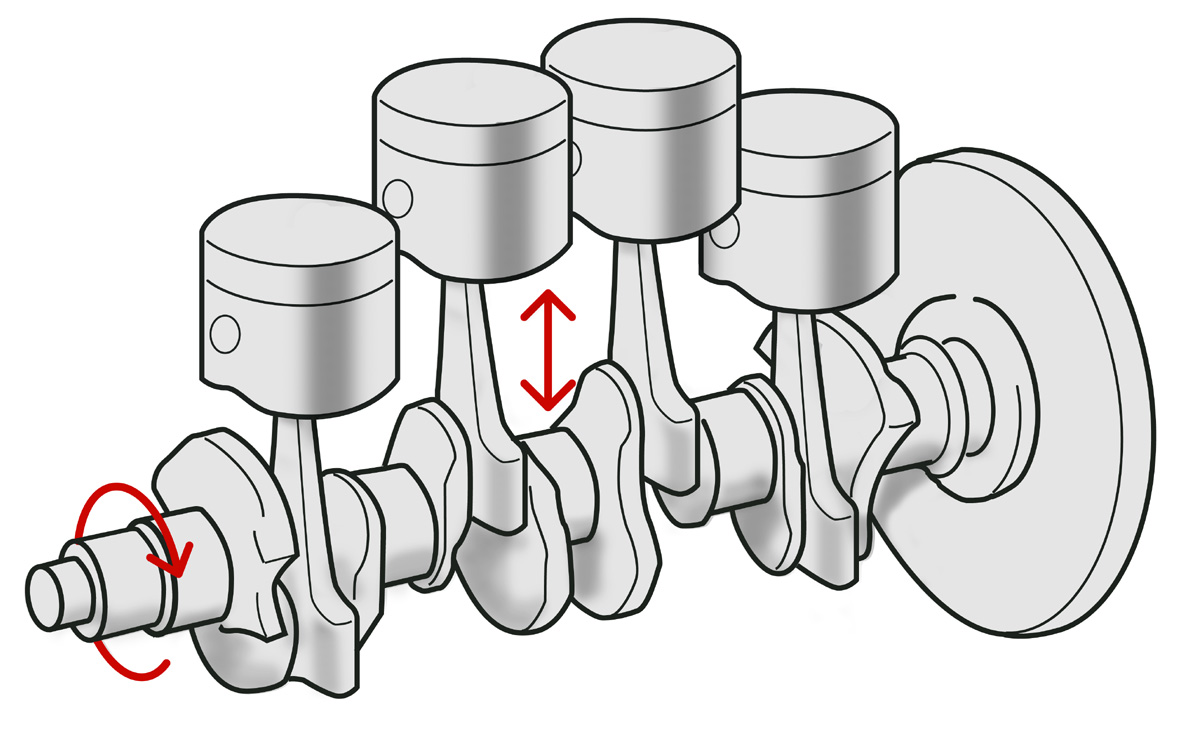
Within a motor, something
has to be off the centerline of the crankshaft
so that as the crankshaft turns one revolution,
a piston is pushed to the top and then pulled
to the bottom
Let’s take a moment and think about the way a crankshaft works. On one end, you have your flywheel, torque converter or clutch. On the other end, there is a timing chain / belt / gear drive, and then a small “snout” sticking out, onto which a damper and any needed accessories are pressed and bolted in place. In between the front and rear, there are main caps and bearings that hold the crankshaft in place in the engine. The number of main caps can differ from two to as many as six, as well as how many bolts are holding them to the block. Attached to the crankshaft, you have the rest of the rotating assembly which consists of connecting rods and pistons with wrist pins and rings. This is where all of the crankshaft twist and harmful “harmonics” truly begin.
The pistons and components travel up and down, to the top of the cylinder and then back to the bottom: one cycle it’s along for the ride, and, one cycle it gets the combustion force pushing it down. Think about that motion within an engine. Something has to be off the centerline of the crankshaft so the crankshaft turns one revolution, a piston is pushed to the top and then pulled to the bottom. If this is a power stroke, where fuel is compressed and combusted, that piston is then forced downward. That is what actually produces your power.
The pedals on a bike act like
the pistons and the crank arm between the pedal
and the chainring is just like your connecting rods.
Think about riding a bicycle and the way you pedal the bike to move. The pedals themselves are like the pistons and the rod between the pedal and the crank sprocket is just like your connecting rods. The pedal arms have to be off the centerline of the crank in order for you to make a circle with the pedals and move your bike forward. Your crankshaft and pistons can be viewed in the same light. Because something has to be off the centerline of the crankshaft in order to function, the leverage of that connection to the crank is very high. That is why the crankshaft will twist as the system is forced to rotate when the engine is fired
While your engine is running, some pistons are being pushed downward on a power stroke, some are being pulled down by the crankshaft, and some are being pushed upward by the crankshaft. Now envision this entire system happening 8,000+ times per minute or 133 times per second! Even further, all of these different forces are acting on the same piece of metal - the crankshaft. These actions make the crankshaft twist in one direction away from its natural home state, and when it tries to come back to that home location, its momentum makes it travel past its original location and farther in the other direction.
The measured magnitude of that action is called “Degrees of Twist – Peak to Peak” or crankshaft twist. This is what I measure when I am damper testing. It is this action that breaks parts and robs you of horsepower when there is nothing to counteract and eliminate the twist. In this system, the worst torsional vibrations, or twist, will always occur at the farthest point from the greatest load, or the heaviest mass. A torsional twist is defined as a twist without a bend. If you get too much of this twist, you will have a bend and this will cause engine and/ or crank failures. Think about twisting a piece of rope over and over; you can make one or two revolutions and nothing happens. After that it starts to get a wave in it, and then as you twist more, the rope will pull your hands closer together.
Once torsional vibrations get to the front of the engine, something there needs to counteract that motion. This is where the damper comes into play. A damper’s job is to absorb and counteract as much of the twist as possible. With the right damper on your engine, the majority of the twist can be eliminated. However, with the wrong damper, virtually all of the twist can remain or even be added to. A damper’s job is to rebound the recoil of a spring. In this case the spring is your crankshaft twisting and when it tries to rebound past that natural state that we discussed earlier, that is when the damper needs to counteract and stop it.
Choose the best damper that your money can buy - an ATI Super Damper.
You can read more about the Dangers of Power Pulleys
here.
Play Video
ATI's Super Damper is the best balancer for your racing engine!